Energy
and Green Roofs: Beyond the Building
Discussions of energy and green roofs are usually focused on the
monthly or annual reductions in one's utility bills, but that is only part of
the picture. What about the energy required to get the green roof components on
the roof in the first place?
In Part 6 of my series Cooler Than Cool Roofs: How Heat Doesn't Move Through a Green
Roof I mentioned that the energy associated with a green roof project
involves more than the heat going in and out of a building. One of the
comparisons I made of green roofs versus reflective "cool roofs" was that the
energy associated with the manufacturing, delivery and installation - known as
the "embodied energy" of a roofing system - is initially higher for green roofs,
but ultimately lower than cool roofs over the life of the building. This is
because a cool roof membrane must be replaced every 20 years or so while a green
roof dramatically extends the life of a roof, possibly for the life of the
building.
Just as embodied energy is expended separately from a building
that is enjoying the benefits of being covered by thriving plants, the energy
being consumed at that building site is typically generated at an equally remote
source. Looking at the biggest picture of a green roof’s impact on the use of
our planet’s energy resources, embodied energy and utility energy expended on
its way to a building are two of the most significant factors and deserve some
attention. The following is a little explanation to help shed some light on the
environmental impact of green roofs beyond the savings seen in a utility
bill.
Embodied energy is a concept that has been around longer than
scientists have been studying the environmental impact of products, including
buildings. Since energy in all its forms has always had some financial cost
associated with it, the idea of including fuel in the chain of costs required to
produce and deliver a product is as old as economics itself.
|
|
Green
Recycling
(1.bp.blogspot.com)
|
In modern economic and environmental analysis, tracking every bit
of energy from every conceivable source spent to create a green roof can be
extremely complex. The array of methodologies is such that a Google search of
“embodied energy” is like trying to find the definitive recipe for chili.
Strictly speaking, to track ALL of the energy provided through modern
technology, one could attempt some extreme analysis and get downright subatomic
about the whole thing. While hardly useful, it is not impossible to calculate
an arcane data point like the energy consumed in the enrichment of the uranium
needed for the fraction of nuclear energy used to manufacture the semiconductor
material used for the computer chips that control the turn signals of the car
driven by the green roof drain mat packaging supervisor to get to the assembly
plant. On the other hand, reports that provide embodied energy values averaged
over an entire category, such as "homes," are too general to be of much use for
a single, specific project.
Embodied energy in the world of green building commonly includes
energy from creation to demolition to recycling into another building. This is
known as "cradle-to-cradle" embodied energy. While energy associated with just
the creation of a building is tricky enough to determine, cradle-to-cradle
studies include estimations of the energy needed to demolish the given building
and dispose of the waste, as well as accounting for the energy that can be saved
by reusing or recycling much of the material. Keeping the potential for
material recycling in mind when designing a building is wonderful, but from a
standpoint of accurate energy accounting, it is purely
speculative.
 |
Illustration
from Ravinia: Her Charms & Destiny via The
GreenestBuilding.org.
|
Somewhere in between a search for energy used by lithium mining
accountants in Argentina and relying on generalized cradle-to-cradle estimates
is found a more pragmatic framework for considering the embodied energy of a
green roof. Realistically, the only energy that should be considered is that
which is directly knowable - the energy that shows up in the utility bills of
the businesses producing, delivering, and installing a product. In fact, it is
little more than a basic set of information that building energy analysts enter
into their models on a regular basis.
The energy used in the production or manufacturing areas of an
industrial building is called process energy and this is also a commonly
reported embodied energy. But we also want to include transportation
energy, which is fairly easy to quantify, as is the installation
energy needed to operate installation equipment. For our purposes they can
be added to process energy to comprise what I propose to call project
embodied energy.
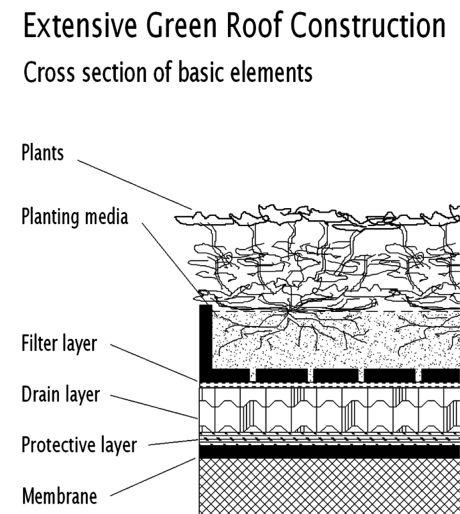
As an example, let’s look at a 4-inch extensive
green roof system with sedums, lightweight growth medium, incorporated
containment/drain layer, and a water-proofing layer being installed on a big-box
store in Chicago. In crude but realistic terms for purposes of this discussion,
one square foot of our system is made up of 12 pounds of expanded clay with a
little bit of compost mixed in, 6 ounces of molded polypropylene, 7 ounces of
TPO sheet, and a plant or two.
 |
Basic
elements of an extensive green roof.
Copyright 2012 Christopher
Wark.
|
As detailed in the following table, the total process energy
required to produce the waterproofing, drainage and expanded clay for the growth
medium is about 36,000 BTUs*, plus a negligible (compared to the rest of
the materials) amount for the compost and plants. These are fairly well
documented average numbers that could be refined for a real project.
Now,
if the growth medium comes from, say, Arkansas, another 3,000 BTUs are needed to
transport it to Chicago if the entire trip is made by truck (900 BTUs if shipped
by train) and 500 Btu is a reasonable number to use for getting the rest of the
materials to the building site since it weighs less and is commonly produced
closer to Chicago.
 |
Combined Process Energy and
Transportation Energy (snake included).
(Courtesy Ian Cheney, Truck
Farm)
|
The amount of energy needed to run machinery for the installation
could be another 500 BTUs, rounding out a grand total of 40,000 BTUs going in to
the basic vegetation of one square foot of a big flat roof in Chicago. Again,
this is a strictly hypothetical project and these energy quantities may be
different for a real project.
Project Embodied Energy of One Square
Foot of an
Extensive Green Roof in Chicago
|
Waterproofing/
Protection
|
Plastic Drain
Layer
|
Growth
Medium
|
Total
|
Process Energy
|
13,000 BTUs
|
11,000 BTUs
|
12,000 BTUs
|
36,000 BTUs
|
Transportation
Energy
|
250 BTUs
|
250 BTUs
|
3,000 BTUs
|
3,500 BTUs
|
Installation
Energy
|
|
|
|
500 BTUs
|
Project Embodied
Energy
|
|
|
40,000 BTUs
|
Are 40,000 BTUs a lot of energy? Sort of. In the grand scheme of
things, we care more about how many BTUs are saved for the building each year by
investing 40,000 BTUs up front. Our one square foot patch of green roof will
save about 1,000 BTUs per year in cooling energy which means that it will take
about 40 years to recover the process embodied energy of the green roof.
By comparison, a cool roof on this building will save about 700 BTUs per
square foot per year. If it has a project embodied energy of 14,000
BTUs, then it will have an initial recovery of 20 years, which is,
coincidentally, a common warranty time for a cool roof. However, after the
initial installation, the installation energy of each replacement is
considerably higher than the first.
That means after 40 years and before the 3rd cool roof has been
installed, the green roof will have recovered approximately 5% more project
embodied energy than the cool roof. The green roof energy advantage
increases from then on.
 |
The
Rockefeller Center Roof Gardens are
78 years old.
(indulgy.com)
|
Well now, that doesn't sound so great, but we are not done looking
at the biggest picture. As I mentioned earlier, energy is also required to
produce and transfer electricity and natural gas to the building. In a way, it
could be thought of as another type of embodied energy, albeit one that is much
more difficult to quantify for a given building than project embodied
energy because electricity and gas are delivered through huge networks with
multiple sources. For electricity, thermodynamic efficiencies of producing
electricity plus transmission losses result in a typical building in the eastern
U.S. being able to use about 1/3 of the original source energy. Natural gas is
a different situation, but nearly all of the savings from a green roof or cool
roof is electrical - primarily cooling and fan energy costs.
This has a
direct effect on how we look at the global energy impact of our green roof. The
1,000 BTUs of savings we see in the building's utility bill translates into a
3,000 BTUs savings for the planet since we only get to use 1/3 of the source
energy. Now the invested energy recovery for our example green roof is only
13.5 years.
Keep in mind that these numbers are not from an actual
project and are for illustrative purposes only. Many companies are still loathe
to release information relating to energy use and a number of trackable details
are left out.
Finally, here is an interesting note: Studies that I
conducted in the past for extensive green roofs on similar types of buildings in
Chicago showed an average cost payback of 14 years.
Coincidence? Not really. When you imagine trying to account for
every single bit of energy embodied in every aspect of this type of project,
money and energy become inextricably linked. This is something to keep in mind
when getting quotes for the installation of a green roof
system.
*BTU is short for British Thermal Unit, which is,
ironically, pretty much only used by the United States anymore. The rest of the
world describes energy using joules or kilojoules.
Chris Wark
WSP Flack + Kurtz
Christopher Wark has 23 years of multidisciplinary engineering
experience providing mechanical, analytical, and electronics support and
services to manufacturers, universities and national labs. For the past 10
years, he has focused his efforts on the development and promotion of technical
solutions in architecture and construction. Chris is currently an Associate with
WSP Flack + Kurtz, conducting building energy analysis.
Before joining
WSP Flack + Kurtz, Chris was a Senior Energy Analyst for Viridian Energy &
Environmental. Previous to that, he provided energy analysis and LEED consulting
services for several companies, including subsidiaries of the Integral Group,
and served as Technical Sales Manager for Mentor Graphics Mechanical Analysis
Division (formerly Flomerics Inc.), offering energy and air flow analysis
solutions for architectural engineers.
In 2002, Chris established SHADE
Consulting/Green Roof Innovations with his wife Wendy. With SHADE/GRI, Chris
developed and marketed several innovative modular eco-roof systems, a roof
system heat transfer and cost computer program, and conducted green roof system
heat transfer analyses for 5 major cities and organizations. In 2010, he
developed a modular planting system in partnership with Guiyang Chuangjia
High-Tech Accelerator Co. LTD in Guiyang, China.
Chris has also been
involved in other thermodynamic related work, including advanced engine research
and fuel cell system development at Caterpillar Inc. and laser development at
Lawrence Livermore National Lab and 2 private research laser development
companies. He has presented at numerous conferences, has several articles
published on a wide variety of engineering topics, and has had the privilege of
working directly with several universities, including Stanford’s Center for
Integrated Facility Engineering (CIFE) program.
Chris holds Bachelor’s
and Master’s of Science degrees in Mechanical Engineering (with a minor in
Materials Science) from Washington State University. His graduate work focused
on thermodynamics, fluid dynamics and combustion.
|